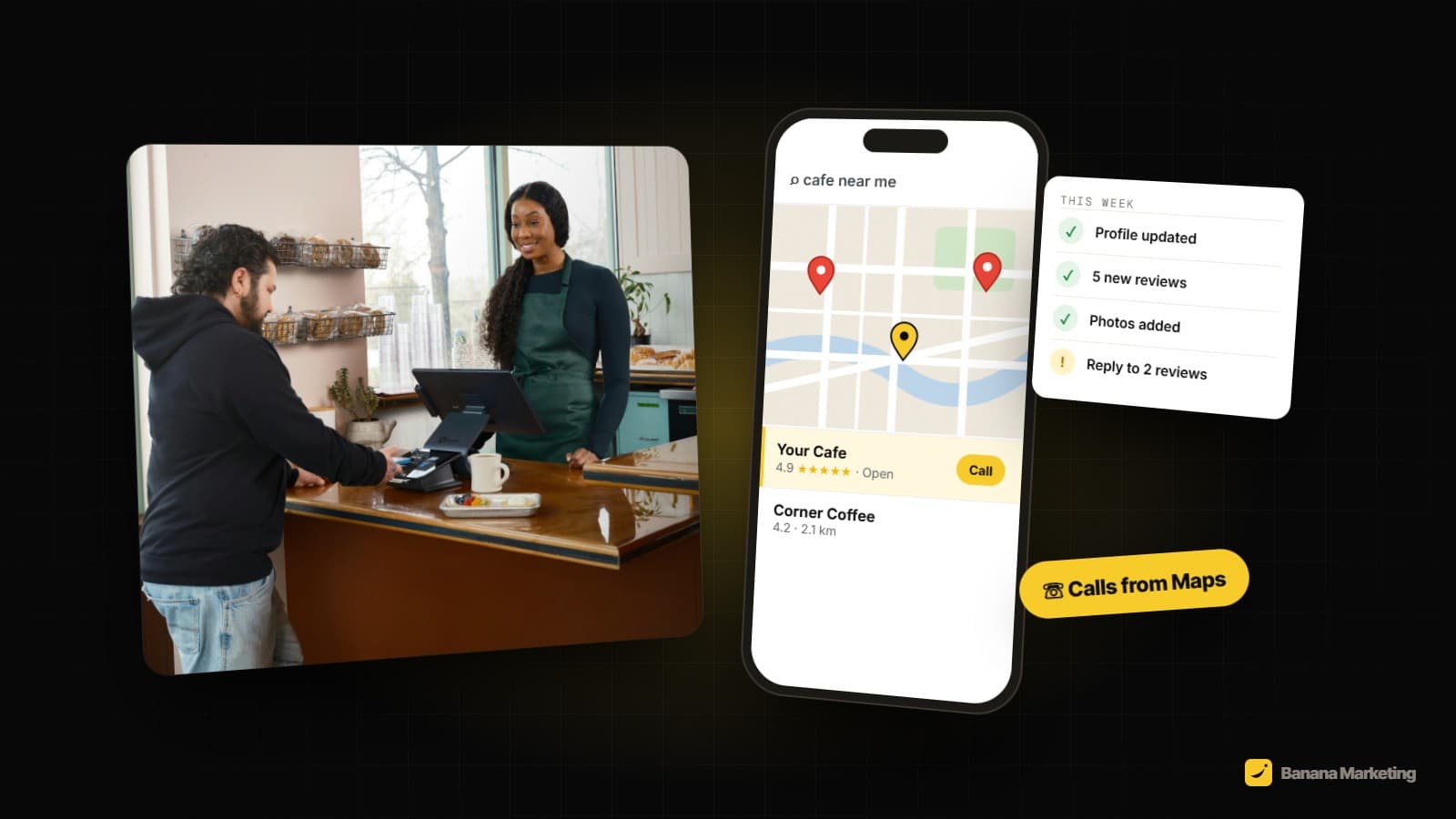
Local SEO for a small business means optimizing a Google Business Profile, reviews, citations and a handful of on-page signals, the same factors any local SEO campaign covers, but run on a tighter budget and usually by the owner. Search demand for "local seo for small business" runs about 3,900 a month in the US, with a keyword difficulty of 10 (Ahrefs, 29 October 2026). Only 35% of US small businesses have claimed a Google Business Profile at all, so the opportunity for the rest starts before any advanced tactic (BrightLocal).
Key takeaways
- Gap: only 35% of US small businesses have a Google Business Profile set up, and just 40% have a dedicated website.
- DIY is the norm: 54% of small business owners manage their own marketing, including local SEO.
- Time cost: a DIY local SEO routine runs roughly 11 to 19 hours a month across 6 recurring tasks.
- Priority: Google Business Profile and review signals hold 52% of local pack ranking weight, so a tight budget starts there first.
- Budget signal: cost holds back 36% of small businesses from investing in any marketing channel at all.
What Is Local SEO for a Small Business?
Local SEO for a small business is the same discipline as local SEO at any size: a Google Business Profile, citations, reviews, on-page local signals and backlinks, working together to rank in nearby search results and the map pack. The difference is resourcing. 72% of US small to medium businesses say SEO has a medium to high impact on their business, yet only 40% have a dedicated website to run it from (BrightLocal).
A small business rarely has a marketing department to split the work across. One person, often the owner, decides what gets done this month and what waits. That constraint shapes every tactic below: each one is picked for the return it gives per hour or per dollar, not for completeness. A business with 2 or more branches follows the same framework but needs multi-location SEO instead, since each branch needs its own profile and page.
Why Does Local SEO Matter for a Small Business?
Local SEO matters because most small businesses have not claimed the basics yet, which makes the remaining work a real advantage. Only 35% of US small businesses have a Google Business Profile, and 54% of owners handle all their own marketing without outside help, according to BrightLocal's 2025 survey of 778 US small business owners and managers (BrightLocal).
That gap means a business that does claim its profile, collects reviews and keeps its listing accurate competes against a majority that has not. Within 3 months, 84% of consumers had searched for a local business, so the demand side of local search is not the bottleneck (BrightLocal). The supply side, businesses showing up correctly, is.
How Much Time Does DIY Local SEO Take Each Month?
A DIY local SEO routine runs roughly 11 to 19 hours a month across 6 recurring tasks, according to seoTuners' breakdown of what owners spend their time on. Google Business Profile upkeep takes 2 to 3 hours, content creation 5 to 8, and citation management, review generation and competitor research each take 1 to 2 hours (seoTuners).
| Recurring task | Hours a month | What it covers |
|---|---|---|
| Google Business Profile | 2–3 | Photos, posts, Q&A responses |
| Content creation | 5–8 | Blog posts, service pages, FAQs |
| Technical monitoring | 1–2 | Search Console and analytics review |
| Citation management | 1–2 | Business directory updates |
| Review generation | 1–2 | Review requests and responses |
| Competitor research | 1–2 | Tracking competitor activity |
An owner with fewer than 11 hours a month free narrows the list to Google Business Profile and review generation first, the 2 tasks a local SEO audit weighs most heavily, and defers content and competitor research to slower months.
Should a Small Business Do Local SEO Itself or Hire Help?
A small business keeps local SEO in-house when it has the owner's time but not the budget, and hires out when the reverse is true. The decision comes down to 3 factors: available time, how competitive the local market is, and which constraint, time or money, blocks progress right now (seoTuners).
A single-location shop in a low-competition market with an owner who can commit 2 to 3 hours a week usually gets further doing the work itself first. A business in a crowded market, or one where the owner's time produces more revenue doing something else, gets more value paying a monthly retainer of $501 to $3,000 for managed local SEO than spending its own hours learning the ropes (WebFX), priced inside Banana Marketing's own SEO packages rather than billed by the hour.
What Local SEO Tactics Give the Best Return on a Small Budget?
Google Business Profile completeness and review activity together hold 52% of local pack ranking weight, more than on-page signals, backlinks and citations combined, so a limited budget covers those 2 areas before anything else (BrightLocal). Both cost time more than money: filling out every profile field and asking recent customers for a review carries no software fee.
Citations and on-page local signals come next, each worth a smaller single-digit share of the ranking weight on their own, but cheap to execute once the profile and reviews are in place. Paid backlink outreach and a dedicated local SEO tool subscription earn their cost only after those free-to-cheap steps are done, since they compete for a smaller remaining share of the ranking outcome. Local keyword research decides which service-area pages to build with those on-page hours, so the content budget targets the search terms customers use instead of guesses.
What Free Tools Can a Small Business Start With?
A small business starts with 2 tools it already has access to at no cost: Google Business Profile's own dashboard, which reports views, calls and direction requests, and Google Search Console, which reports which search terms already bring in clicks. BrightLocal also publishes a set of free local SEO tools, including a citation tracker and a local search grid checker, that need no paid account to run a first pass (BrightLocal).
These free tools cover the diagnostic step: finding what is missing or broken. A paid citation-tracking subscription becomes worth its monthly fee once a business manages listings across 5 or more directories or locations and a spreadsheet stops being practical.
What Local SEO Mistakes Do Small Businesses Make Most Often?
The most common mistake is neglecting the Google Business Profile entirely, matching the 35% claim rate above: most small businesses have nothing to neglect because they never set one up. The next most common error is publishing content before the profile and citations are fixed, spending the content hours from the table above on a foundation that cannot support it yet (Morningscore).
A third recurring mistake is treating local SEO as a single project with an end date instead of a recurring routine. A profile left unedited for months, a review request that stops going out, or a citation that goes stale after a house move all undo earlier work quietly, with no single event marking when it happened.
What Belongs on a Small Business Local SEO Checklist?
A small business local SEO checklist covers 7 steps across the first 90 days, moving from the Google Business Profile outward to backlinks in the same order as their ranking weight. Banana Marketing sequences a new small-business client's work this way, so the highest-return task happens first rather than whichever one feels most urgent that week.
- Weeks 1–2: claim and fully complete the Google Business Profile: category, hours, service area, photos.
- Weeks 2–4: request reviews from the last 90 days of customers and reply to every existing review.
- Weeks 3–5: check NAP consistency across the website and the 10 most-used directories for the business's category.
- Weeks 5–7: add or fix one local-intent page per core service, naming the city and service in the title and heading.
- Weeks 6–9: add LocalBusiness schema markup matching the visible name, address and phone number.
- Weeks 8–11: pursue 2 to 3 local backlinks, from a chamber of commerce, a local news mention or an industry directory.
- Weeks 10–12: re-run the free Google Business Profile and Search Console checks and compare against week 1's baseline.
Local SEO for Small Business FAQ
Is local SEO worth it for a small business?
Yes. 72% of small to medium businesses say SEO has a medium to high impact on their business, and only 35% have claimed a Google Business Profile, leaving an open gap for the rest.
How much does local SEO cost for a small business?
Monthly retainers for local SEO services run $501 to $3,000, according to WebFX's 2026 local SEO pricing guide, or free to a few hours a week if run as DIY.
Can a small business owner do local SEO themselves?
Yes. 54% of small business owners already manage their own marketing, and a DIY local SEO routine runs about 11 to 19 hours a month.
What should a small business do first for local SEO?
Claim and complete the Google Business Profile first. It holds a share of the 52% of local pack ranking weight that Google Business Profile and reviews together carry, and costs no money to fix.
What is the biggest local SEO mistake small businesses make?
Neglecting the Google Business Profile entirely. Only 35% of US small businesses have one set up at all.
The Bottom Line
Local SEO for a small business is a sequencing problem before it is a budget problem: claim the Google Business Profile, collect reviews, and fix citations before spending any hour on content or backlinks, since those first 2 areas hold 52% of the local pack ranking weight on their own. Most competitors have not done this yet, since only 35% of US small businesses have claimed a profile at all. Request local SEO services for small businesses from Banana Marketing to see which of the 90-day checklist steps above your business still needs.